Thirty million passengers moved through Philadelphia International Airport in 2025 — and somehow, every one of them needed to get to or from a different terminal. For a solo traveler with a carry-on, that problem solves itself. For a group of 45 flying in together for a conference at the Pennsylvania Convention Center, or 55 heading home after an Eagles away trip, the math changes fast.
The moment someone's Southwest flight into Terminal F and someone else's American connection through Terminal B land twenty minutes apart, you have a coordination problem that no number of rideshare apps fully solves. A Philadelphia airport charter bus rental collapses that problem into one pickup, one drop, one flat number — and Zone 8 on the South Commercial Roadway is where it all comes together on the arrivals side.
This guide covers exactly what your group needs to know: where the bus drops departing passengers, where it stages for arrivals, how to navigate the arrivals-versus-departures level confusion that trips up first-timers, how to use the Cell Phone Lot, how long to build into your timeline for a full group clearing baggage claim at each terminal cluster, and what the per-person math looks like compared to rideshares and on-site parking. Every fact here is pulled from PHL's own published pages — no invented gate numbers, no guesswork on curb rules.
Why a Philadelphia Charter Bus or Party Bus Rental Makes Sense for Airport Groups
A fair question before you book anything: does your group actually need a bus, or is it overkill? A pair of business travelers with carry-ons can SEPTA from Terminal F to Suburban Station in about 25 minutes for $6.75 a head with a Key card. That option is real and it works.
But once your group reaches 10 or more people — especially if anyone is checking luggage — the logic flips. SEPTA's Airport Line runs every 30 minutes with a stop at each terminal cluster, but coordinating 50 people hauling suitcases onto the same train from scattered terminals is a logistical disaster in slow motion.
Rideshares have their own math problem. At $35–65 per car and four people maximum, moving 40 people means 10 separate cars, 10 different pickup windows, 10 ETAs that never quite sync, and a post-landing surge that makes a $40 estimate cost $65 by the time the last person lands. That is $650–$1,300 in rideshares round-trip, versus a single 40–56 passenger charter bus that handles the entire group in one move — and splits to roughly $10–18 per person once the hourly rate is distributed across the headcount.
The bus also eliminates the coordination problem entirely: one pickup location, one departure window, everyone boards together with bags in the undercarriage bays, and the group rolls out together.
For corporate groups flying into PHL for the Pennsylvania Convention Center (1101 Arch Street, Philadelphia, PA 19107), hotel blocks in Center City, or event venues across the region — a Philadelphia charter bus rental is the standard answer most groups arrive at after doing the math once. Call 267-521-1350 or use the online quote tool for a free estimate in under a minute.
PHL Terminal Layout: What A-West Through F Means for Your Group
Philadelphia International Airport has seven terminals arranged in a roughly linear layout: A-West, A-East, B, C, D, E, and F. All are connected post-security by a walkway — but the walk from A-West to F is approximately 30 minutes on foot. That matters significantly if part of your group lands in one terminal and part in another.
The broad breakdown: Terminals A-West and A-East handle American Airlines' primary operations, including international arrivals — A-West is the international terminal for transatlantic carriers including Aer Lingus and British Airways, and international arrivals clear U.S. Customs and Border Protection at A-West before retrieving bags. Terminals B and C, connected by a shopping corridor, serve additional American Airlines domestic routes. Terminals D and E are linked via a post-security walkway.
Terminal F — the easternmost terminal, home primarily to Southwest Airlines — also has its own SEPTA Airport Line stop (Terminal E/F), one of several station stops the line makes along its route through the airport; that matters even if your whole group is taking the bus, since it tells you where scattered members who grabbed a train on their own will enter the city.
Each terminal has its own baggage claim on the ground level. This matters for groups with members on different flights: if half your group flies American into Terminal B and half flies Southwest into Terminal F, you are managing two separate baggage claim pickups roughly 30 minutes apart — inside the airport, after security. A charter bus staging at Zone 8 while coordinators confirm everyone has bags in hand is the most practical answer to a split like that.
The official PHL terminal guide has the current airline-by-terminal breakdown — check it before your date, since assignments occasionally shift.
Charter Bus and Party Bus Drop-Off at PHL: The Departures Level
For departing groups, PHL is straightforward: buses drop passengers on the upper (departures) level at the curb for each terminal. The departures road is the upper roadway — the one where everyone pulls up to unload luggage before a flight. Your group unloads at whatever terminal matches their flight, and the bus moves on.
What the airport enforces strictly: vehicles on the departures curb are for active loading and unloading only. PHL states plainly that vehicles left unattended at the curb will be towed, and curbs are actively monitored by officers who will direct you to move if you stop without actively unloading. A charter bus cannot park, idle, or wait at the departures curb between stops.
The sequence is clean: group off, bags out, bus exits. If your group is split across two terminals — say, one flight out of Terminal B and another out of Terminal F — the bus makes its stops in sequence and exits after the second drop. Plan that sequence before departure day: the order, the timing between stops, and whether the group at each terminal has someone designated to move the group to the curb efficiently when the bus arrives.
Charter Bus and Party Bus Pickup at PHL: Zone 8 on the South Commercial Roadway
This is the section most groups wish they had read before their trip. Arrivals at PHL do not happen at the same curb as departures — they happen on the lower (arrivals) level, on the South Commercial Roadway behind baggage claims, in organized zones numbered 1 through 8. Charter buses and courier services have their own designated zone: Zone 8.
Here is how the commercial zones are arranged per PHL's official ground transportation page: Zones 5 through 8 sit on the South Commercial Roadway side of baggage claim — not on the Arrivals Road side. Zone 5 is taxis, Zone 6 is hired limos and vans, Zone 7 is Uber and Lyft, and Zone 8 is exclusively for charter buses and couriers. Passengers exit baggage claim and cross to Zone 8 on the commercial roadway — it is separate from the rideshare and taxi zones, so your group knows exactly where to converge without hunting through a crowd of commuters and airport shuttles.
The GPS address arriving passengers should use is 8000 Essington Avenue, Philadelphia, PA 19153 — the arrivals-level address, not any terminal-specific departures address. Using the departures address for a pickup sends the bus to the wrong level entirely. Every arriving group member should have "8000 Essington Ave, Zone 8" saved before they land.
For any last-minute coordination or questions on the day of, PHL's Airport Communications Center can be reached at 215-937-6937.
Zone 8 on the South Commercial Roadway is the only correct pickup location for charter buses at PHL. The regular arrivals curbside and the Cell Phone Lot are for personal vehicles. If your group is being picked up by a bus and someone says "meet us outside the terminal," they will be at the wrong curb — Zone 8 is behind baggage claim on the commercial roadway side, across from the general arrivals flow.
Have every group member save "8000 Essington Ave, Zone 8" before the flight lands.
The Arrivals-vs-Departures Level Confusion That Catches Groups Out
PHL's layout catches first-timers consistently, and it is worth understanding before your trip. Unlike most airports where departures and arrivals flow through the same roadway system, PHL has departures and baggage claim on different floors of the same building — and the baggage claim is accessed across the road from the main terminal entrance. Departures are on the upper level; baggage claim and commercial ground transportation (Zones 5–8) are on the lower level.
The practical result: if someone sends a charter bus to the terminal address on a departure boarding pass, it arrives at the upper level — the wrong side. The bus needs the arrivals/lower level address (8000 Essington Avenue) and access to the South Commercial Roadway to reach Zone 8. And if a group coordinator instinctively follows signs for "terminal arrivals" and ends up circling the upper departures road, that is a confusing 20-minute loop before they sort it out.
The rule is clean: upper level is for departures and drop-offs only; lower level is for arrivals and commercial pickups. One level, one direction of traffic, no exceptions. The PHL meeting passengers page confirms the layout and includes Cell Phone Lot directions for those staging nearby.
Cell Phone Lot Staging: How It Fits Into Group Pickup Timing
PHL offers a complimentary Cell Phone Waiting Lot for vehicles picking up arriving passengers. It accommodates 150 vehicles, is accessible from both I-95 and Route 291, and sits less than a one-minute drive from baggage claim. The rules are simple: vehicles must stay attended at all times, and the maximum wait time is 60 minutes.
It is free, and it keeps vehicles off the arrivals curbside — where unattended vehicles are towed — while waiting for a group to clear baggage.
For charter buses, the Cell Phone Lot plays a specific coordination role: the bus stages near the lot while the group coordinator confirms that all passengers have their bags and the group is fully assembled at Zone 8. Only when that confirmation comes does the bus move to the South Commercial Roadway for active loading. This is the right sequence because Zone 8 is an active loading zone, not a parking area — a charter bus cannot simply occupy Zone 8 for 40 minutes while a 50-person group trickles through three different baggage carousels.
The coordination call ("all bags accounted for, heading to Zone 8 now") is what triggers the bus to move from staging to pickup position.
For a group of 30–50 people on the same domestic flight: allow 30–45 minutes from wheels-down to full group assembly at Zone 8. Bags typically start appearing on the carousel about 10–15 minutes after landing, but clearing a full carousel for a large group on the same flight — bags spread across multiple carousels, slower members working through the crowd — can push the realistic timeline to 25–40 minutes. Plan for the longer end.
A bus staged at the Cell Phone Lot for 35 minutes beats a bus stuck at Zone 8 with officers asking it to move while the group is still at baggage carousel 19. Per PHL's guidance, the Arriving Flights roadway is available for circling personal vehicles — for a charter bus, the Cell Phone Lot staging approach is cleaner and easier on everyone.
International Arrivals at Terminal A-West: Build In the Extra Buffer
If any part of your group is on an international flight, the pickup timeline changes substantially. Most international arrivals at PHL clear U.S. Customs and Border Protection at Terminal A-West. After the plane gates, passengers join the CBP queue — which, depending on the time of day and the number of transatlantic flights arriving in the same window, can run anywhere from 30 minutes to 90 minutes or more before bags are in hand.
After clearing customs, bag retrieval happens at the baggage claim in the A-West and A-East area.
For a mixed group — some members on international flights into A-West, others on domestic connections at Terminal B or F — the international arrivals will always be the last ones to Zone 8. Build the pickup window around the international arrivals, not the domestic ones. The realistic buffer for international arrivals from wheels-down to Zone 8: 75–120 minutes, depending on the CBP queue.
Domestic groups: 30–45 minutes for a group of 30 or more. If the bus moves to Zone 8 the moment the domestic flight lands, the group may wait in the Zone 8 lane for the international arrivals for 45 minutes or more — which creates congestion and pressure. The smarter sequence: domestic arrivals confirm full assembly at Zone 8, get picked up and loaded, and international arrivals get their own coordinated pickup in a second wave.
Two clean movements beat one rushed one. Current international arrival schedules are on PHL's flight information page.
PHL Airport Transportation Options Compared: Charter Bus vs. Every Other Way
An honest breakdown — this site compares transportation, and a charter bus is not automatically the right answer for every group size. Here is how the options stack up for 40 people arriving at PHL together.
| Option | Cost shape (40 people) | Arrive together? | Luggage | Coordination effort | Best for |
|---|---|---|---|---|---|
| Charter bus (40–56 passenger) | One hourly rate, split across the group (~$10–18/person for a 2–3 hour block) | Yes — one vehicle, one Zone 8 pickup | Full undercarriage bays; handles full checked-bag loads | Minimal — one coordinator, one pickup point | Groups of 15–56 with luggage |
| Rideshare (Uber/Lyft) | ~$35–65/car × 10 cars each way = $700–$1,300 round trip, plus post-landing surge | No — 10 separate pickup windows, 10 ETAs | Trunk space only; checked bags are a squeeze | High — 10 separate coordination points | 1–4 people, no checked bags |
| SEPTA Airport Line | $6.75–$8.75/person × 40 = $270–$350 total; every 30 minutes | Only if all 40 board the same train | Carry-on sized; checked luggage is a problem on crowded trains | High — group members scattered across multiple terminal stations, 30-min headway | Solo travelers or pairs traveling light |
| Taxis | $32 flat rate to Center City × ~10 cabs = $320+ | No — 10 separate cabs, separate arrivals | Trunk space only | Moderate — queuing at Zone 5 | Small groups, 1–4 per cab |
| Driving + on-site parking | Up to $32/day upper garage per vehicle; 10 vehicles × 5 days = $1,600 in parking alone | No — separate vehicles, separate timing | Trunk per vehicle only | High — 10 separate vehicles, 10 parking passes, 10 independent routes | 1–2 people, very short trips |
The SEPTA Airport Line deserves a specific note because it is the alternative most group planners mention first. For one or two people with carry-ons, it is a legitimately good option — you will be at Suburban Station within 25 minutes of boarding for $6.75. For 40 people with checked bags spread across multiple terminals, boarding every 30 minutes, coordinating everyone onto the same train from different terminal platforms?
That is a 90-minute coordinated exercise that still costs $270–$350 in fares and leaves everyone scattered. SEPTA's details are on PHL's public transportation page — a real resource for individual members of your group who travel solo. For the group itself, Zone 8 is the answer.
On-site parking at PHL adds up quickly for large groups. The upper-level garages run up to $32/day per vehicle — and Garage C is currently closed for upgrades, reducing available spaces across the terminal garages. Ten vehicles parked 5 days at upper-garage rates equals $1,600 in parking fees before gas or tolls.
One charter bus at a flat rate split across the group usually costs less per person than day three of that parking bill. That is when renting a bus stops being an upgrade and starts being the practical decision.
Getting to PHL: Driving Routes, Distances, and Where I-76 Bogs Down
PHL sits about 10 miles southwest of Center City via I-95, and the airport is well signed from every major approach — but the traffic behavior on both main routes is predictable and worth factoring into your bus departure window.
The two standard routes from the Philadelphia metro area:
I-76 East (Schuylkill Expressway) to I-95 South: From Center City, take I-76 eastbound, follow the merge onto I-95 South, and exit at Exit 12A-B for Route 291 toward airport terminals. The Schuylkill Expressway is one of the region's most consistently congested highways, and the merge where I-76 feeds into I-95 near the airport is among the worst bottlenecks in the Philadelphia area — especially between 4:00 and 7:00 PM on weekday afternoons. For early-morning departures, this route is clean.
For mid-afternoon ones, build in extra time or consider routing via surface streets closer to the airport.
I-95 South directly: From I-95 southbound (approaching from I-676 or from Northeast Philadelphia), take the same Exit 12A-B for Route 291. Groups coming from New Jersey: NJ Turnpike Exit 3 to the Walt Whitman Bridge, then I-95 South to Exit 12A-B. From Delaware: I-95 North straight to Exit 12A-B. From the PA Turnpike: Route 476 South toward Chester, then I-95 North to Exit 12A-B.
Approximate drive times from common group origins (off-peak conditions):
| From… | Approx. distance | Typical off-peak drive time |
|---|---|---|
| Center City Philadelphia | ~10 miles | 20–30 minutes |
| University City (Penn / Drexel campus) | ~8 miles | 15–25 minutes |
| South Philadelphia | ~6 miles | 15–20 minutes |
| Northeast Philadelphia | ~15 miles via I-95 S | 25–35 minutes |
| King of Prussia / Valley Forge | ~22 miles via I-76 E | 30–45 minutes |
| Cherry Hill, NJ | ~14 miles via Walt Whitman Bridge | 25–35 minutes |
| Wilmington, DE | ~28 miles via I-95 N | 30–40 minutes |
During weekday rush hours — 7:00 to 9:30 AM and 4:00 to 7:00 PM — add 15–30 minutes to any of those estimates, and more for the I-76 approach during the afternoon window. For any departure that lines up with those hours, the bus window should account for it. 511PA has real-time conditions on your travel date, which PHL's own traffic and transit page also links to for current advisories.
What Size Bus Does Your Group Need for a PHL Airport Transfer?
Airport transfers have one requirement above almost all others: luggage capacity. Your headcount and your checked bag count together determine the right vehicle — and at an airport, undercarriage bay space is not optional. Here is how the vehicle lineup breaks down for a PHL run.
| Vehicle | Passengers | Luggage capacity | Best for at PHL |
|---|---|---|---|
| Sprinter van | Up to ~12–14 | Rear cargo area — good for light luggage or carry-ons | Small executive groups, same-terminal pickups |
| 14-passenger Sprinter limo | Up to 14 | Modest — best for lighter luggage loads | VIP arrivals, small corporate groups |
| 15–35 passenger minibus | 15–35 | Overhead racks plus underfloor storage | Mid-size conference groups, sports team travel, wedding parties |
| 40–56 passenger charter bus | Up to 56 | Large undercarriage bays — handles multiple checked bags per passenger | Large conference groups, conventions, major event arrivals and departures |
For airport transfers specifically, the charter bus's undercarriage bays are the decisive advantage. A group of 40 conference attendees each checking two bags — 80 pieces of luggage — needs serious undercarriage space, not overhead bins. The 40–56 passenger charter bus handles that load with room to spare: reclining seats, overhead storage for carry-ons, deep undercarriage bays for checked bags, onboard restrooms for longer post-airport drives to suburban hotels or event venues, and climate control that makes the wait in Zone 8 comfortable on a July afternoon.
For a mid-size group of 15–35 people with moderate luggage, a minibus is the more efficient fit — more maneuverable on the arrivals roadway, and better on the per-person cost math for a group that does not need all 56 seats. ADA-accessible vehicles are available through the network — note it in your quote request.
Philadelphia Airport Charter Bus Rental Prices
Airport transfers price differently from point-to-point city runs because the billing clock runs from when the vehicle leaves its staging location — not from when it meets your group at Zone 8. A transfer from a Center City hotel to PHL for a group departing at 6:00 AM may have a 4:30 AM vehicle call time factored into the block. The quote accounts for total vehicle time, not just the trip segment you see.
That is worth knowing before comparing prices.
To give you a planning range: a 40–56 passenger charter bus runs roughly $200–$350 per hour on weekdays through the network serving Philadelphia. A standard airport transfer — pickup in Center City, drop at PHL departures, in a 2–3 hour block — puts the total bus cost in the range of $400–$700. Split across 40 people, that comes to roughly $10–$17.50 per person, one way.
A minibus for a group of 20–35 runs $200–$250 per hour on weekdays. These are planning ranges — the actual quote moves with your pickup location, group size, date, and total hours. A pricing estimate for your exact trip takes about a minute: fill out the online form or call 267-521-1350.
Check the Philadelphia party bus prices page for rate ranges across all vehicle types, or call 267-521-1350 any time — a support team is available every day of the year at no obligation.
An Airport Transfer Example
To give you an idea: a corporate group of 42 employees departing after a five-day conference books a 56-seat charter bus. Pickup at a Center City hotel at 5:30 AM, departures drop at Terminal B (American Airlines) by 6:15 — well clear of the I-76 congestion that starts building by 7:00 AM. On the return leg — same 42 people arriving on mixed flights at Terminals B and F — the bus stages at the Cell Phone Lot while the group coordinator confirms all bags are retrieved at each terminal.
The bus moves to Zone 8 once the full group confirms assembly, and the group is at the hotel before the last person off a SEPTA train has even cleared the 30th Street Station platform. A 2.5-hour block for a 56-seat charter bus at that size, split across 42 people, comes in below what most of those employees paid in rideshares the first night of the conference.
Frequently Asked Questions About Charter Bus Rentals to Philadelphia International Airport
Where exactly does a charter bus pick up passengers at PHL?
Charter buses pick up at Zone 8 on the South Commercial Roadway, which runs behind baggage claims on the lower (arrivals) level of each terminal. Zone 8 is exclusively for charter buses and courier services — separate from rideshare pickup (Zone 7), taxis (Zone 5), and limousines and hired vans (Zone 6). The correct GPS address for arrivals-level pickup is 8000 Essington Avenue, Philadelphia, PA 19153.
The departures-level terminal addresses are for drop-offs only — never for pickups.
Where does a charter bus drop off departing passengers at PHL?
Charter buses drop off on the upper (departures) level at the curb for each terminal. The drop is active — vehicles cannot park, idle, or wait at the departures curb, and PHL actively enforces towing of unattended vehicles. The bus stops, the group unloads with bags, and the bus exits.
For groups split across multiple terminals, the stop sequence is planned in advance.
Can a charter bus use PHL's Cell Phone Lot?
The Cell Phone Lot is a free, 150-space lot with a 60-minute maximum wait, accessible from I-95 and Route 291. It is primarily designed for personal vehicles. For a charter bus, the standard protocol is to stage near the lot while the group coordinator confirms all passengers and bags are assembled at Zone 8 — and then the bus moves to Zone 8 for active loading.
For specific questions about oversized vehicle staging, PHL's Airport Communications Center at 215-937-6937 can advise.
How long from landing to Zone 8 pickup for a group of 30–50 people?
For a domestic group of 30–50 people on the same flight: 30–45 minutes from wheels-down to full group assembly at Zone 8. Bags arrive on the carousel roughly 10–15 minutes after landing, but clearing a full group's luggage and walking to Zone 8 realistically takes 25–40 minutes. Plan for the longer end.
For international arrivals clearing customs at Terminal A-West: 75–120 minutes from wheels-down, depending on the CBP queue. Build the pickup window around the slowest expected arrival, not the fastest.
What does PHL parking actually cost, and how does it compare to a charter bus?
Upper-level garage parking at PHL runs up to $32 per day per vehicle, and short-term ground-level spaces can reach $54 per day. Ten vehicles parked for a five-day conference in the upper garage: $1,600 in parking fees alone, before gas or tolls — plus Garage C is currently closed for upgrades, tightening available spots across the terminal garages. One charter bus at a split per-person rate typically beats that math by departure day three.
Current rates are on PHL's official parking page — confirm before your trip, as rates can change.
Which airlines fly from which terminals at PHL?
American Airlines operates primarily through Terminals A-West, A-East, B, and C. Southwest Airlines is primarily at Terminal F, which also has a SEPTA Airport Line stop. Terminals D and E handle additional domestic carriers. For your specific flight's terminal, confirm with your airline directly — the terminal can occasionally change for operational reasons, and it determines which departures curb the bus uses.
How do groups arriving from New Jersey or Delaware get a charter bus to PHL?
From South Jersey: NJ Turnpike Exit 3 to the Walt Whitman Bridge, then I-95 South to Exit 12A-B for Route 291. From Cherry Hill or Camden: the Walt Whitman Bridge is the fastest crossing — about 14 miles to PHL. From Wilmington, DE: I-95 North to Exit 12A-B. A charter bus pickup from a Cherry Hill or Wilmington hotel before a group departure, or a Zone 8 pickup after arrival, works the same as any Philadelphia metro origination — just note the origin in your quote request.
Cherry Hill bus rentals and Wilmington party bus rentals are available through the same network.
Is SEPTA a realistic option for large groups with luggage?
For individuals and pairs traveling light: yes — $6.75 per person with a SEPTA Key card, every 30 minutes, about 25 minutes to Center City. For groups of 15 or more with checked luggage: not practical. The Airport Line makes stops at each terminal cluster (Terminal A-East, Terminal B, Terminal C/D, and Terminal E/F), so a group scattered across different flights lands at different platforms and still has to reassemble onto the same train.
Trains run every 30 minutes, which rarely aligns with a large group's full assembly time. And crowded trains are not built for multiple checked bags per person. For your individual members who want to break off and head downtown solo, the SEPTA details are on PHL's public transportation page.
For the group, Zone 8 is the right answer.
How far in advance should I book an airport charter bus in Philadelphia?
For standard corporate group transfers, two to three weeks out is workable on most dates. During major conference season in Philadelphia — spring and fall, when the Pennsylvania Convention Center is at capacity and hotel blocks city-wide fill up — four to eight weeks is safer. Spring also brings Phillies home openers at Citizens Bank Park and Eagles Draft events that pull on the same vehicle supply.
Book as soon as your flight details are confirmed: the vehicles go to the first groups that call, and the earlier you lock the date, the better your selection.
Booking a Philadelphia Airport Charter Bus or Party Bus Rental
Getting a quote through Partybusinphiladelphia.com comes down to one form or one call: date, group size, origin or destination, and flight timing. From there, you compare vehicle options and pricing across a large network of bus companies serving the Philadelphia region — no account required, no obligation, a pricing estimate in under a minute.
For airport transfers specifically, the details that shape the quote are group size, checked luggage volume, the pickup or drop-off address, the terminal (if known), and your flight time buffer. Departing groups should plan to be at the departures curb at least two hours before flight time, with bus departure from origin accounting for drive time plus a buffer for I-76 or I-95 congestion. Arriving groups should build 30–45 minutes from wheels-down to Zone 8 for domestic flights and 75–120 minutes for international — and the coordinator's phone should be charged and connected before the plane lands.
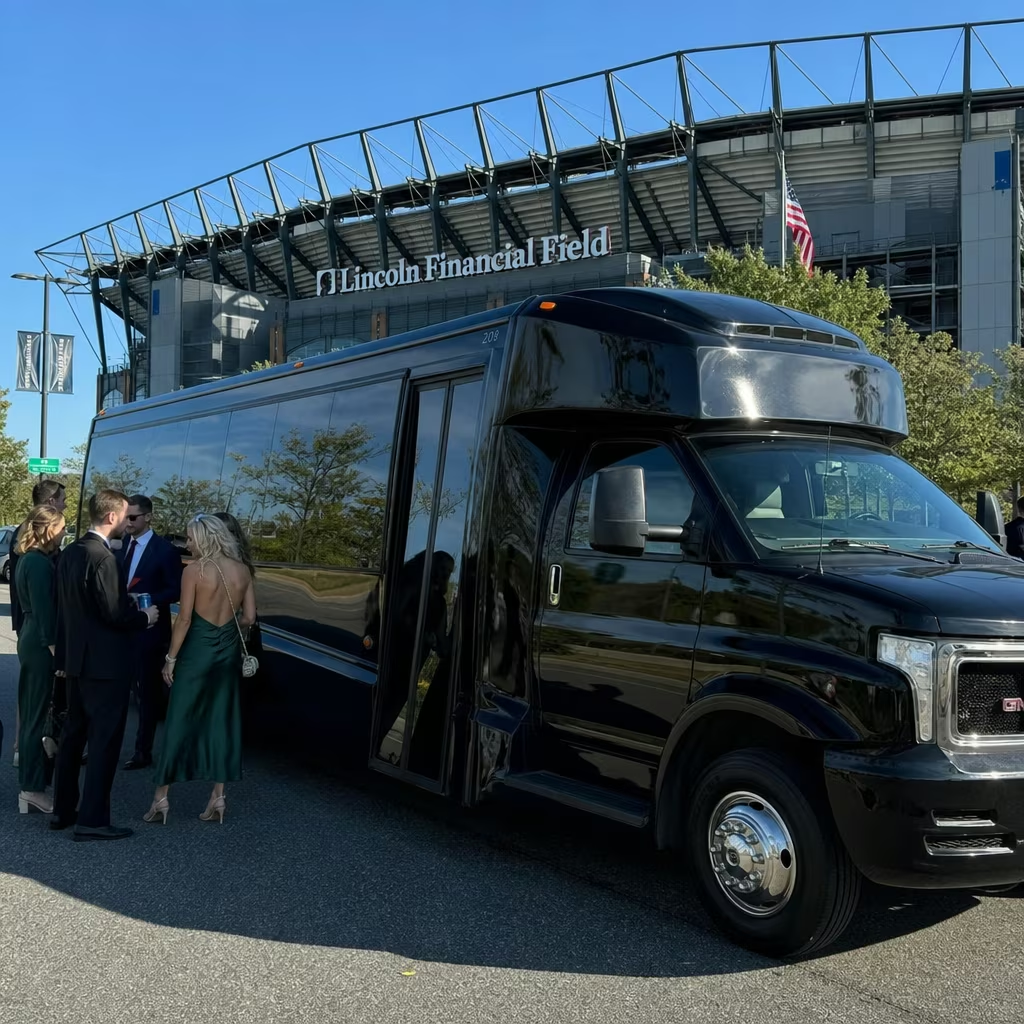
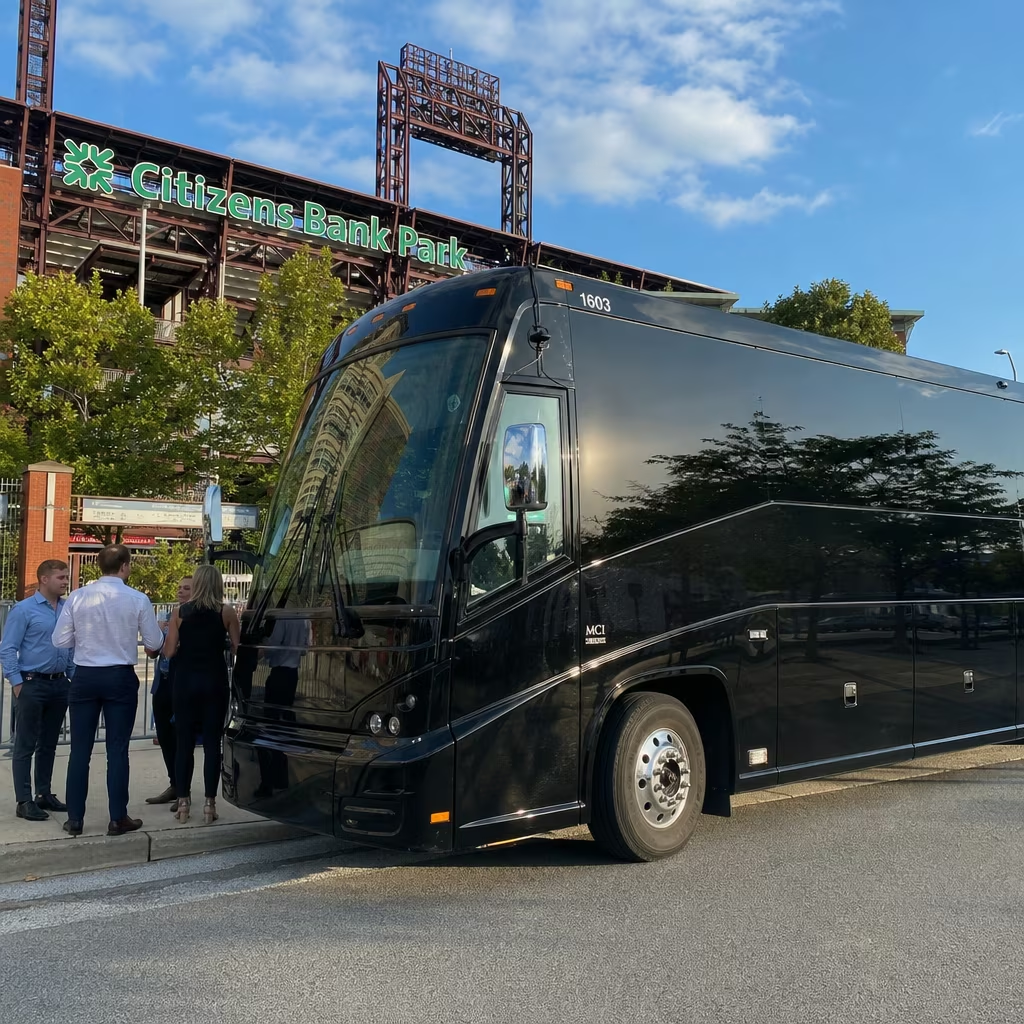
If your trip includes a stop beyond the airport — Lincoln Financial Field the night you land, Citizens Bank Park the next afternoon — the same network handles multi-stop itineraries. The Lincoln Financial Field transportation guide and Citizens Bank Park bus guide cover those venue logistics in the same depth as this one. And for the full scope of group transportation across the Philadelphia region, the Philadelphia group transportation services page covers everything from corporate shuttles to wedding party transfers.
Call 267-521-1350 any time — a support team is available every day of the year — or use the online tool to compare vehicles and see pricing for your exact airport transfer. No account required. No obligation.
Just the quote.